[Disclaimer: The stats are taken from Wikipedia and some of my words/opinions may strongly support the practices of Sanatana Dharma. It is probably because I follow the same principles. Please accept my ignorance.]
I was not sarcastic while I set the title to the post. Obviously, everyone knows their age. But I did a research after a question that got triggered in my mind. What is the age of earth? What is the age of the universe where the earth and our solar system is surviving? Although the question as quite simple, in the sense that even a high school student will ask it, the details of the answer could vary depending on the age and level of understanding the person asking this question. I request you to read till the end of the post even if you have no interest/skip the Sanskrit words of this post.
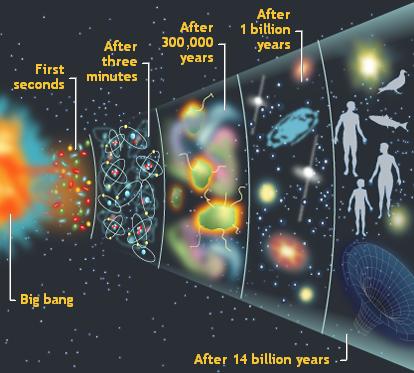
Science (astrophysics) did not give me a solid answer to my question. I went through few sites over the internet and every one quoted approximate values. The most concrete answer being 13.8 billion years since big bang and varying somewhere between 15-20 billion years. However, I did not get satisfied with what Science has answered. I further did some more research in Wiki and found out how the Sanatana Dharma (Hinduism, although I don't like to call it that way) has given some statistics and calculations which no other "ism" has even given a thought. Further to this, the Vedas and Puranas gave exact figures of the age of the universe, which is a small thing when compared to the entire chronology theory proposed by the same Vedas. In its simplest format, see the following calculations. This is all based on how Lord Brahma creates and destroys the universes. Also, there are two scales of time in this, one is Brahma year and the other one is human year. I am not going into more details of how Lord Brahma creates it but all I wanted to talk here is about the time scales.

Also you can reverse calculate the current age of Brahma and current age of this Universe. There are multiple universes. And the cycle rotates with a new Brahma after every 100 Brahma years.
We are in currently in 5116 year of the Kali Yuga of the 28th Mahayuga of the 7th Manvantara (Vaivaswatha Manvantara) of the 1st Brahma Day (Swetha Varaaha Kalpa) of 51st year (Dwitiya Parardha) of Brahma. For completion of this Mahayuga we are yet to complete Kali Yuga which is 5115 years complete out of 432000 years. For a person who knows about "Sankalpam" of a ritual performed in Sanatana Dharma, this is the time classification that is read.
One can question the validity of this theory. This is not accepted nor proved by Science. Well, I believe science may "discover" this in future. From the science end, the Wiki page says that the Hindu Chronology provides the closest figures to the figures what are quoted by Science. This is what Wikipedia says in their article. This article from Wikipedia is an interesting read where there are quotes mention from various works of Sanatana Dharma like Bhagavat Puran, Srimad Bhagavatam, and The Gita etc. It gives an introduction to various characters like Kakbhushubdi who sees everything everywhere outside normal time, somewhat similar to the "Griffin" character in MIB 3. More interesting things can be understood from the same article which mirrors the concept of a world with in a world and a universe with in another universe as shown in Hollywood blockbusters like "MIB 1" and "A journey to the center of the earth". Another reference is in an article about What Vedas say about age of universe?
Apart from the fact I got amazed after going through all these articles and stats, I am also left with a feeling like how small our life is? Out of 100 years of human life, we spend sleeping for about 50 years. The rest of 50 years, I don't know how far we are able to spend most of it useful. I guess this is where the spiritual knowledge on a religion and practicing the concepts of a particular religion would help. They keep you in the right path, make you do good for the future generations. And still, we spend life with ego, impatience, hatred and dissatisfaction. What a pity! Time to realize!! Time for a change!!
I was not sarcastic while I set the title to the post. Obviously, everyone knows their age. But I did a research after a question that got triggered in my mind. What is the age of earth? What is the age of the universe where the earth and our solar system is surviving? Although the question as quite simple, in the sense that even a high school student will ask it, the details of the answer could vary depending on the age and level of understanding the person asking this question. I request you to read till the end of the post even if you have no interest/skip the Sanskrit words of this post.
Science (astrophysics) did not give me a solid answer to my question. I went through few sites over the internet and every one quoted approximate values. The most concrete answer being 13.8 billion years since big bang and varying somewhere between 15-20 billion years. However, I did not get satisfied with what Science has answered. I further did some more research in Wiki and found out how the Sanatana Dharma (Hinduism, although I don't like to call it that way) has given some statistics and calculations which no other "ism" has even given a thought. Further to this, the Vedas and Puranas gave exact figures of the age of the universe, which is a small thing when compared to the entire chronology theory proposed by the same Vedas. In its simplest format, see the following calculations. This is all based on how Lord Brahma creates and destroys the universes. Also, there are two scales of time in this, one is Brahma year and the other one is human year. I am not going into more details of how Lord Brahma creates it but all I wanted to talk here is about the time scales.
- Lord Brahma - life is 100 Brahma years.
- 1 Parardha = 50 Brahma Years (Currently we are in Dwitiya parardha, 2nd set of 50 Brahma years)
- 1 Brahma year = 365 Brahma days
- 1 Day of Brahma = 2 Kalpas (1 Kalpa - Brahma Day (time of creation and destruction), 2nd Kalpa - Brahma Night (time of sleep))
- 1 Kalpa = 14 Manvantaras
- 1 Manvantara = 71 Mahayuga
- There is a gap of 4 Charanas after every Manvantara (which will be a total of 6 MahaYugas for 1 Kalpa). So in a more detailed way
- 1 Kalpa = 14 Manvantara + 6 Mahayuga = 14*71 Mahayuga + 6 Mahayuga = 1000 Maha Yuga
- =>1 Kalpa = 1000 Maha Yuga
- 1 Maha Yuga = Total years in 4 Yugas (Satya, Treta, Dwapara, Kali) = 4,320,000 human years
- Satya Yuga - 4 Charanas - 4 x 432000 human years (Charana = Feet of the cow that represents Dharma)
- Treta Yuga - 3 Charanas - 3 x 432000 human years
- Dwapara Yuga - 2 Charanas - 2 x 432000 human years
- Kali Yuga - 1 Charana - 1 x 432000 human years
- Total human years in Maha Yuga = 4320000
- One human year = 2 Aayana
- 1 Aayana = 6 months
- 1 Month = 2 Paksha
- 1 Paksha = 15 Human Days
Also you can reverse calculate the current age of Brahma and current age of this Universe. There are multiple universes. And the cycle rotates with a new Brahma after every 100 Brahma years.
We are in currently in 5116 year of the Kali Yuga of the 28th Mahayuga of the 7th Manvantara (Vaivaswatha Manvantara) of the 1st Brahma Day (Swetha Varaaha Kalpa) of 51st year (Dwitiya Parardha) of Brahma. For completion of this Mahayuga we are yet to complete Kali Yuga which is 5115 years complete out of 432000 years. For a person who knows about "Sankalpam" of a ritual performed in Sanatana Dharma, this is the time classification that is read.
One can question the validity of this theory. This is not accepted nor proved by Science. Well, I believe science may "discover" this in future. From the science end, the Wiki page says that the Hindu Chronology provides the closest figures to the figures what are quoted by Science. This is what Wikipedia says in their article. This article from Wikipedia is an interesting read where there are quotes mention from various works of Sanatana Dharma like Bhagavat Puran, Srimad Bhagavatam, and The Gita etc. It gives an introduction to various characters like Kakbhushubdi who sees everything everywhere outside normal time, somewhat similar to the "Griffin" character in MIB 3. More interesting things can be understood from the same article which mirrors the concept of a world with in a world and a universe with in another universe as shown in Hollywood blockbusters like "MIB 1" and "A journey to the center of the earth". Another reference is in an article about What Vedas say about age of universe?
Apart from the fact I got amazed after going through all these articles and stats, I am also left with a feeling like how small our life is? Out of 100 years of human life, we spend sleeping for about 50 years. The rest of 50 years, I don't know how far we are able to spend most of it useful. I guess this is where the spiritual knowledge on a religion and practicing the concepts of a particular religion would help. They keep you in the right path, make you do good for the future generations. And still, we spend life with ego, impatience, hatred and dissatisfaction. What a pity! Time to realize!! Time for a change!!

